
Despite AG Warnings, Senator Hired by Auditor’s Office, Sponsored Legislation to Expand Agency’s Power
The state's top lawyer warned that it could violate the West Virginia Constitution for a state agency to hire a lawmaker. The Auditor hired him anyway.
Written by Kyle Vass, May 19, 2026
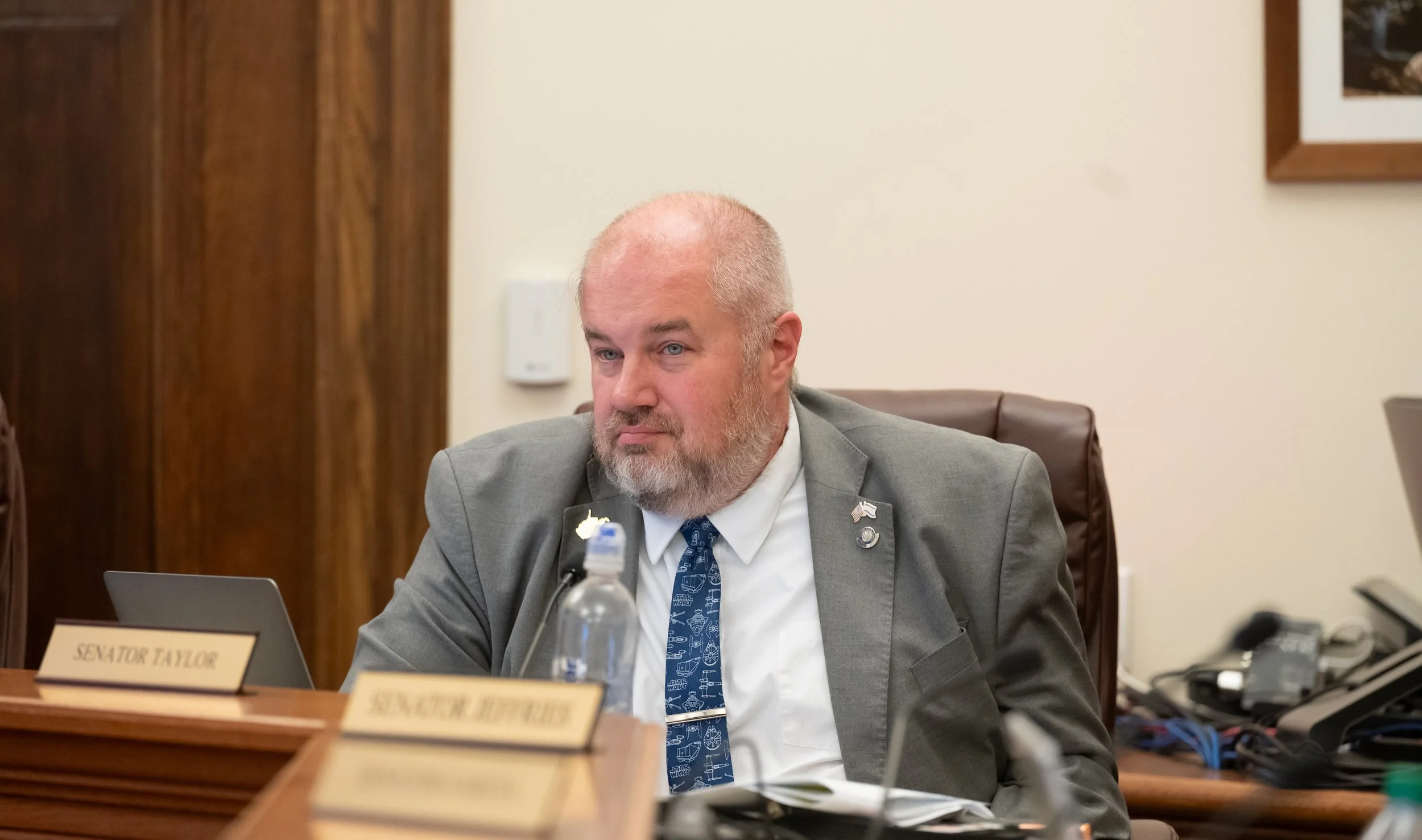
West Virginia State Senator Jay Taylor (R — Taylor) sits in a Senate Transportation and Infrastructure committee meeting on March 9, 2026. (Photo by Will Price / WV Legislature Photography)
On October 16, 2025, West Virginia State Auditor Mark Hunt reached out to West Virginia Attorney General JB McCuskey asking him to weigh in on the legality of a legislator working as a contractor or employee of a state agency. Attorney General McCuskey responded in a letter replete with warnings. The most “obvious restraint”, McCuskey wrote, was Article VI, Section 15 of the State Constitution that “flatly declares that no member of the Legislature may ‘be interested, directly or indirectly, in any contract with the state, or any county thereof, authorized by any law passed during the term for which he shall have been elected.”
Nevertheless, State Auditor Hunt hired Senator Jay Taylor (R — Taylor) as a contractor the following month that closely resembles a typical full-time job. Taylor was given a state government email address and a government-issued computer waiting for him on his first Monday on the job. He was added to the internal staff distribution list for the Local Government Services Division. He used official agency titles ("Budget-Finance Specialist" and later "Coordinator") in his email signature. Every morning he sent check-in emails to three supervisors reporting when he had arrived (including on snow days he wrote in to say he was working from home).
Taylor even referenced full-time employment in an email with WVSAO Chief of Staff Michael Cook, saying "the regular state job was supposed to be $75K with benefits.” In arguing his contractor rate should be adjusted to somewhere between $47 and $55 per hour to compensate for taxes, lack of benefits, and no guaranteed hours, Taylor wrote, “I appreciate the opportunity, but $20 an hour is only $40K a year. And as a contractor I have to do my own taxes and benefits.
“That really puts me close to minimum wage. I figure this is a just an [sic] oversight as I believe the regular state job was supposed to be $75K with benefits. Since I'm not doing that and doing the contractor route my hourly should be considerably more.
“If a $75k salaried job comes wrapped in the warm blanket of full benefits, a contractor must knit their own blanket — health insurance, retirement, payroll taxes, time off, everything. That means the hourly rate must rise to cover the ‘hidden’ value of benefits,” Taylor wrote in his email.
When presented with this email and asked for comment, Taylor denied that “doing the contractor route” was a workaround for the prohibitions against lawmakers serving as employees of state agencies. Taylor responded, “I would not have entered into the contract if I believed it was prohibited, and I do not agree with the suggestion that this was a workaround or an improper conflict,” adding that he was under the belief that this arrangement had been reviewed with the Attorney General.
Records show Auditor Hunt didn’t provide specific details when he reached out to Attorney General McCuskey. Auditor Hunt’s request for an opinion from the Attorney General was three sentences: “At your earliest convenience, and pursuant to W.Va. Code §5-3-1, please provide your written opinion as to whether there are any prohibitions-statutory, constitutional, or otherwise on a sitting member of the West Virginia Legislature also serving as either a contractor or as employee of an agency within the executive branch of our state government. Thanks in advance for your review, consideration, and anticipated opinion on this issue. Don't hesitate to reach out if you have questions or wish to discuss.”
In his response, Attorney General McCuskey (who served as the State Auditor before Mark Hunt) writes that hiring a lawmaker as an employee would be an outright violation of the West Virginia Constitution. McCuskey goes on to add that hiring a lawmaker as a contractor could also violate the law in three different ways.
First, as Article VI, Section 13 of the West Virginia Constitution prohibits employment of a lawmaker, this would include a contractor who assumes the functions and duties of a regular employee can be deemed a de facto employee, making the distinction between "contractor" and "employee" legally meaningless if the working arrangements are indistinguishable from employment.
Second, the common law incompatibility doctrine (rooted in WV precedent dating to State ex rel. Thomas v. Wysong, 125 W. Va. 369 (1943)) can independently bar concurrent service in two roles whose duties conflict, regardless of whether any specific statute is violated. The AG concluded that without more details about the specific contractor arrangement, he could not confirm every provision that might apply, but that "a person should exercise caution."
Third, Article VI, Section 15 prohibits a legislator from being "interested, directly or indirectly, in any contract with the state...authorized by any law passed during the term for which he shall have been elected." The AG flagged this as "perhaps the most obvious restraint.” A legislator with a financial relationship with an executive agency cannot vote on or sponsor laws that affect that agency's interests.
Yet, in his dual-role as contractor and lawmaker, Taylor began using his contractor relationship with the Auditor's Office to advance his own legislation in the Senate.
On January 29, 2026, Taylor emailed his WVSAO supervisor Michael Cook a draft bill he was developing called the "Taxpayer Transparency in Education Act," which proposed requiring county Boards of Education to submit annual financial reports to the State Auditor. The following morning, Auditor's Office Chief Counsel Scott Caudill responded (addressed to "Senator Taylor" at Taylor's personal Yahoo account, with Cook copied) with a detailed legal memo walking through which code sections to use, which references were wrong, and how to best achieve the bill's legislative objective.
Taylor was the lead sponsor of Senate Bill 929. Its central provision (a new §18-9-7) would bring all 55 county Boards of Education in West Virginia under WV Code §6-9-1 et seq., the the statutory framework the Local Government Services Division — the same division Taylor worked for while contracting with WVSAO — administers.
SB 929 cleared the Senate Education Committee on February 25, 2026. The following day, Caudill emailed Taylor again to confirm the committee substitute version of the bill would successfully bring county BOEs under WVSAO oversight. The bill passed through the Senate with unanimous support but didn’t advanced out of the House Education subcomittee before the end of the 2026 Legislative Session.
Neither the Attorney General's Office nor the Auditor's Office responded to a request for comment prior to publication.